All join hands: What square dancing means to Inverness County culture and community
June 25, 2026
Many people in Inverness County know the feeling of walking into a square dance.
From the parking lot of a community hall, you can already hear it: lively fiddle tunes, the rhythm of dancers’ feet on the floor. At the door, a friendly face welcomes you in.
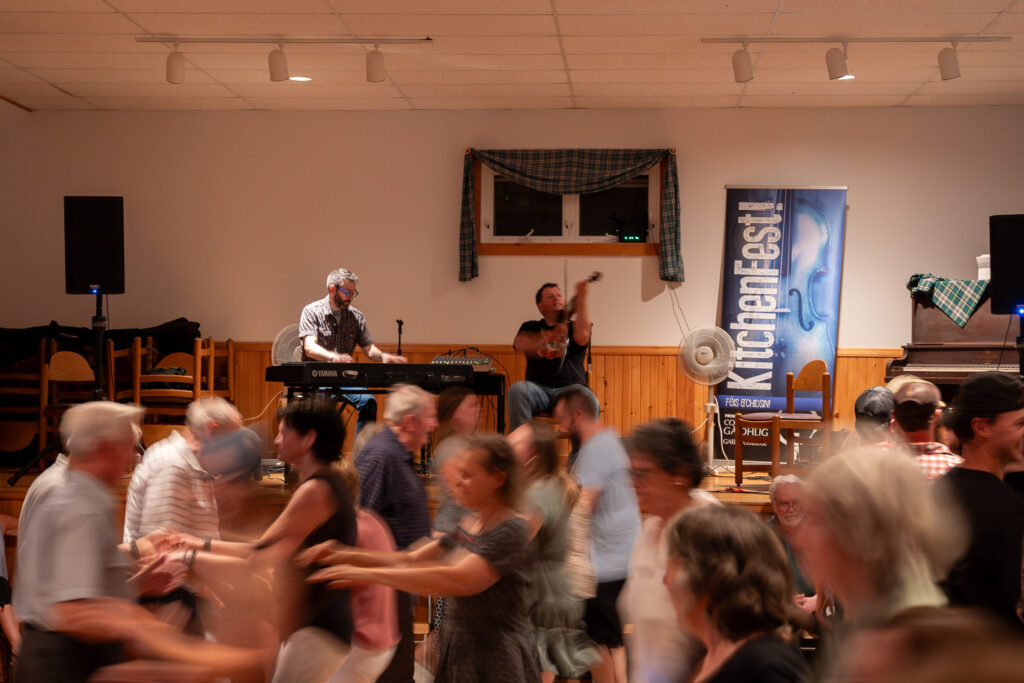
Inside, the floor is full of dancers of all ages dancing together, moving through sets in what can only be described as organized chaos. Somebody might call out “all join hands!”, telling the dancers to form the circle that starts the set. It quickly becomes obvious that this is something special, and it feels like you’ve stepped into a place you didn’t know still existed.
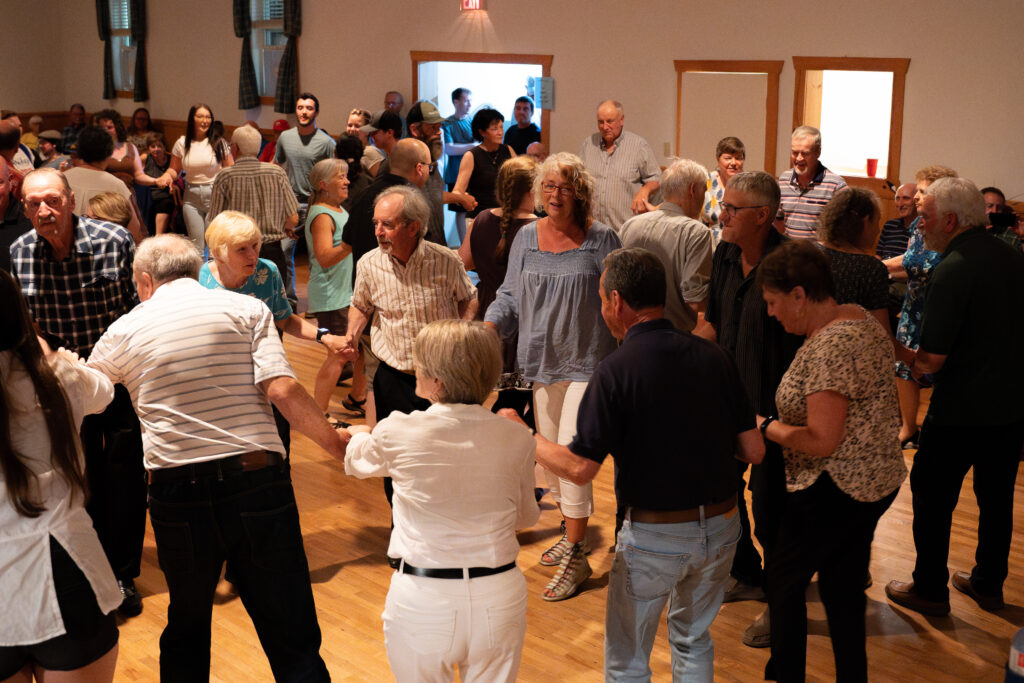
Across Inverness County, four main weekly square dances anchor the summer: Brook Village on Mondays, Glencoe Mills on Thursdays, Southwest Margaree on Fridays, and West Mabou on Saturdays.
In July and August, those dances feel like they are alive and well with a long life still to go. But outside of that peak season in June or September, they start to feel more fragile, less certain than they were before.
For Gaels in Cape Breton, dancing is not just entertainment or recreation. The dance tradition is integral to the culture at large. It is what has kept fiddle music so rhythmic, and it offers a way to participate, not just observe.
Square dancing is something people do together. Whether it’s your first time or your hundredth, whether you’re eight or 85, whether you’re from Mabou, Margaree, Malibu, or the Mainland, you can join a set and take part in something bigger, a tradition that has survived hundreds of years and (at least) a few colonial attempts to ban it.
For many, that experience runs deep.
My mother started bringing me to dances when I was about four years old. I learned the sets, built relationships with older generations and found friends my own age. My connection to Gaelic culture—and to Inverness County itself—was shaped in those halls. It’s what tied me to this place, even when I lived in Newfoundland and Alberta.
Without those experiences, I’m not sure I would have been as determined to come home before I turned 30.
I’m not alone in that feeling.
“Dances are a really neat intergenerational meeting place,” says Hannah Krebs, a Gaelic speaker who moved to Nova Scotia from Ontario about a decade ago. “I’ve learned a lot from dancing and watching older generations. And as a Gaelic learner, dances have been a place where I can run into other speakers and use the language.”
For Sarah MacInnis of West Mabou, dances were also formative.
“They introduced me to a lot of the older generation in the community,” she says. “As a homeschooler, they were a big part of my social interaction.”
They also offered an early lesson in community responsibility.
“I learned a lot about giving back by watching Jimmy and Margie,” she says, referring to her aunt and uncle, who established the West Mabou dances in the 1980s.
Experiences like Hannah’s, Sarah’s, and mine point to something larger. Square dances are about more than just the dance tradition. They are key experiences and part of a larger cultural and social fabric.
That sense of belonging is part of what made a moment in September 2025 so striking.
On September 20, David Greenwell of Hillsborough shared a photo of an almost empty West Mabou Hall on a Saturday night. Musicians Shelly Campbell and Allan Dewar were ready to play, but there weren’t enough people there to form one set.
The image sparked concern across the dance community. It was a wake up call that the future of square dances might not be as secure as was once thought.
For Greenwell, the significance of dances goes back decades. He and his wife, Michelle, began visiting Inverness County from Alberta in the 1990s with their young children.
“Dances were what sold us on Inverness County,” he says. “They were a fun thing to take the kids to, and they were a one-stop shop for all things social and cultural.”
The family moved to Hillsborough full time in 2010 and have been faithful supporters and volunteers for dances and most community-based events in the Mabou area ever since.
“After moving, I started to see that dances reflect a lot about life here,” Greenwell says. “They’re volunteer-driven, and it’s up to the community to support them—this idea of ‘if I don’t go, who will?’”
That idea gets at something essential. Square dances reflect many of the qualities people value about Inverness County: strong volunteerism, a responsibility to each other, cultural depth, world-class local talent and a rare level of intergenerational connection.
They are, in many ways, a microcosm of the community itself.
In that same vein, square dances also reflect many challenges that exist in Inverness County communities.
So when dances struggle, it raises a broader question: what does that say about the community, and where it’s headed?
Derrick Cameron is the president of the West Mabou Development Association. He and his wife Melody have been the driving forces behind the West Mabou Dances since 2016.
“A strong culture makes a community a better place to live,” he says. “It gives people something to belong to, and something to stay for.”
But maintaining that culture takes work. Across the county, organizers of all kinds of events point to a familiar set of challenges: aging volunteers, burnout, shifting attendance since the COVID-19 pandemic and the financial realities of maintaining community halls. Recent provincial cuts to arts, culture and visitor information centres have added further strain.
These challenges are complex and addressing them requires nuance. There’s likely no one-size-fits-all answer, but there are some suggestions floating around.
Volunteerism, in particular, is a key issue.
“To pass the torch, there has to be someone willing to take it,” Cameron says. “But the person passing it on also has to be open to new ideas.”
That transition is not always straightforward. Many long-time organizers have carried the load for years, and replacing them requires both willingness and support.
There is also a shift happening on the dance floor. Many of the tradition bearers who have long led sets and taught younger generations the way are getting older and attending less frequently. At the same time, the tradition seems to have skipped a generation, so you don’t see a lot of people in their 40s to 50s at dances consistently, and the 20- to 30-somethings may not be quite ready to take the lead.
There is an excellent opportunity to use square dances as a tool to welcome newcomers and help them find their footing in the community, but there is also a level of intimidation that comes with jumping in on a seemingly well-established tradition.
“We were lucky when we started coming that a few key dancers literally took us by the hand and showed us how to do the sets,” Greenwell recalls. “But on nights when there are more new dancers than experienced ones, that can be tricky.”
That raises a practical question: how can dances become more accessible?
Some suggest building guidance into the events’ structure. Callers who walk dancers through each step, or floor managers who help keep sets small and ensure there is an experienced couple in each group.
Small adjustments like these could lower the barrier to entry while preserving the spirit of the tradition.
At the same time, there is a temptation to rely on tourism. Well, it’s already happening, really. Dances happen primarily through the summer months when there are visitors around and people home from away, all eager to experience culture in Inverness County.
But there is also caution to be taken if we’re going to gear the tradition more towards visitors than for the people who live here.
Cameron recalls a conversation during a trip to Barga, Italy, to attend a dance festival put on by Hamish Moore–a renowned tradition bearer and bagpipe maker from Scotland.
While there, Cameron struck up a conversation with a local artist, asking him “what makes your community work, and what are the challenges?”
The artist told the story of the community, that it had faced economic decline due to industrial closures, and was then exploring tourism as a new economic driver. But locals had concerns about what commodifying their culture meant for the traditions they held so close. Sound familiar?
Later in the trip, the man showed Cameron a piece of his art that featured wine evaporating out of a tumbler-style wine glass over time. He explained that those glasses were what the locals typically drank their wine out of, but as time went on and those glasses broke in the town’s restaurants, they were replaced with the modern, aesthetic stemmed wine glasses that many visitors would expect.
The change was subtle, almost invisible as it happened, but meaningful all the same.
The story resonates in Inverness County.
Tourism can support local culture, but it can also reshape it. The question becomes not just how to attract visitors, but how to ensure traditions remain rooted in the community that have carried them.
At the same time, it is important to recognize that culture is not static. Across Inverness County, there are signs of renewal and adaptation.
The region is home to North America’s only Gaelic-medium school, Taigh Sgoile na Drochaide in Mabou. Regular sessions at venues like the Admiral in Port Hood and An Drochaid in Mabou, along with milling frolics at the hall in Skye Glen, point to continued interest in Gaelic language and music.
These spaces matter. They show that culture is still being lived, even as it evolves.
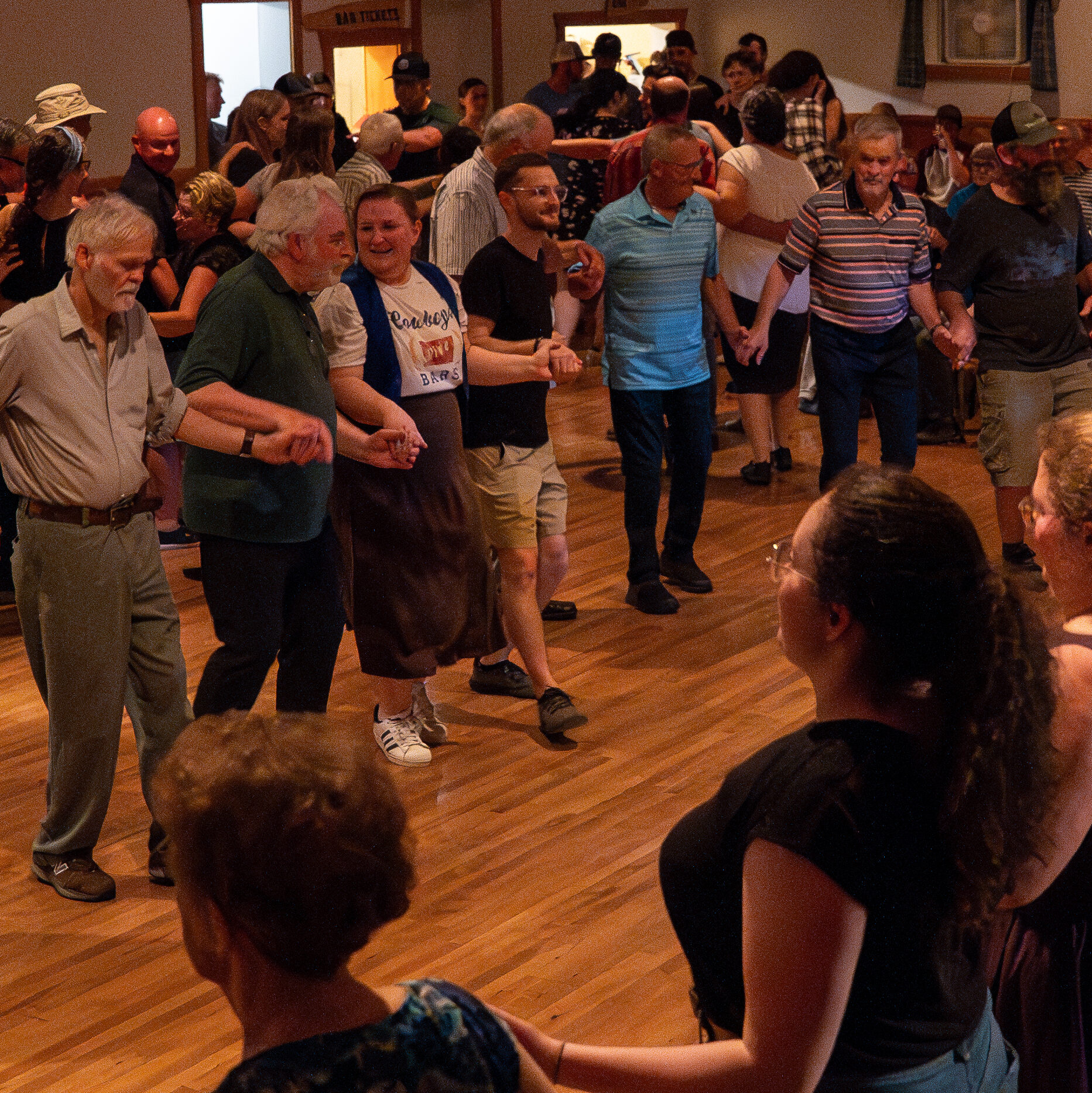
But square dancing occupies a particular place within that landscape.
If there are no dances, fiddlers still play for ceilidhs, concerts, and jam sessions; step dancers will still give solos in the same spaces; the sets themselves may even be presented by rehearsed groups as performances. But the sense of togetherness, community, and belonging are diminished when it’s performed for an audience, instead of lived by the people taking part.
By the time this issue of The Participaper reaches readers, the summer season will be underway. Dance halls will fill again. People will reconnect with neighbours they haven’t seen all winter, welcome those returning home and greet visitors experiencing it for the first time.
These dances matter—to the cultural life of Inverness County and to its social fabric.
But they endure only if people come through the door and all join hands.