Plants on the move: Transplanting tips
December 22, 2025
Maybe a special plant just isn’t doing well, and it wasn’t really meant for that shady spot that you wanted to fill. Maybe a plant is doing so well that it is bullying its neighbours and needs a “time out.” Perhaps a friend admires a showy flower, and you want to share it.
As the garden settles in for the winter, this is a good time to “plan your next move.” Transplanting is one of the easiest gardening tasks, but if technique and timing aren’t considered, it can end poorly. The big challenge for the plant is that you are disrupting its roots’ ability to get water to the leaves when you move it. Knowing a few details encourages transplanting success.
Plants have to breathe. Their leaves have pores (stomata) that let air enter, and they use the carbon from carbon dioxide (CO2) as a building material, and to store energy as carbohydrates. But where air comes in, moisture escapes, particularly on dry, windy days. This evaporation is what draws water up the plant from the roots.
If more water is lost from the leaves than supplied by the roots, the plant will wilt, and if severe enough, it may not recover. The best strategy is to take the leaves out of the equation, by making the move when the plant is dormant – any time after the leaves fall, but preferably in early spring, before they come out again, or as they are barely emerging. This is usually “no fail” if you don’t damage the roots too much.
Make sure that the plant is watered well in advance, so that the roots have time to absorb the water. I often have a bucket of water on hand and just drop the newly dug up plant in and let it sit for about an hour (also great for preparing your seedlings for transplanting).
If the plant is actively growing, it is best to plan for an evening move, so that it has the night to recover (and stomata close at night in most plants). Overcast and mild days are great, and if it is sunny or windy, I will place a bucket upside down over it afterwards (or a loose plastic bag), so that the humidity will be kept high around the leaves to reduce evaporation, while also making sure it doesn’t get cooked in there!
Moving a plant in bloom is not recommended because it will set it back a bit, but removing the blossoms will help to lessen the stress on the plant.
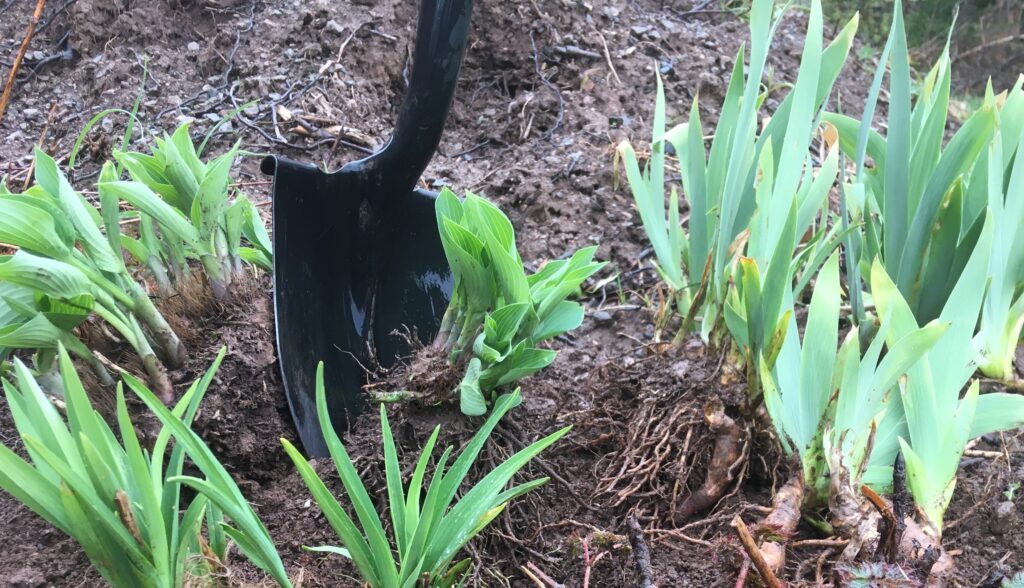
Transplanting a smaller plant can be as easy as driving your shovel in and lifting the whole root ball in the soil. Don’t remove more soil from the roots than necessary, but you can gently tease apart a clump and pull out any weeds that you see.
For a larger plant, imagine that the full root system is roughly the same size as the above-ground part. Use a shovel to loosen the roots far from the stalk, then use a pick or a garden fork to dig down deep under the plant and pry it out. If the whole root ball doesn’t come easily, work to loosen the roots more. Patience is your friend.
Dig out the hole and loosen the ground where you plan to place the plant and set the plant in at the same level as before. Don’t fertilize, except for a bit of bone meal for the roots. Loosely place the soil in around it and water very well. After the water soaks in, gently firm down the soil to remove large air spaces. I often leave a very shallow hollow to allow water to pool, rather than run off.
You can reduce the damage caused by shock when moving a plant from a shady spot to full sun by using a piece of fabric or a structure to provide some shade for a few days.
Research the plant first, in case there’s some detail that will encourage success. For example, if you transplant a biennial that is in flower (like lupines or hollyhocks), it flowers in its second growth year, and doesn’t typically grow back for a third year, so it is on its last legs. Among the large plants, you’ll find little one year-old plants that will produce flowers the next year, and you may also get some seeds in the soil along for the ride.
Perennial flowers such as day lilies, asters, daisy, hosta, or phlox, are essentially a clump of many individual plants, each with its own root. With care, any piece that you dig out will certainly have a few intact plants in there, even if you’ve had to take an axe to the clump to break it apart! Many perennials are very hardy, and if set back, will still spring up from their roots the next year.
Woody shrubs or trees with a single trunk and large root system require greater care. All of the above apply, and special effort is required to work out as much of the root system as possible. Root pruning the previous season, and cutting back the size of the shrub can also help.
Happy Gardening!
Caroline Cameron lives in Strathlorne and is the Food Security Coordinator at Mill Road Social Enterprises. Please submit any gardening tips, questions, and news to strathlorne@gmail.com and visit Facebook at Nature/Nurture Gardening & Hiking.